
For many of us, the kitchen feels like a second workplace. After a long day of making decisions, answering emails, and managing schedules, the thought of standing over a stove can feel like a burden. We often rush through it, trying to get the “task” of eating out of the way so we can finally sit on the couch. But what if we shifted our perspective? Instead of seeing cooking as a chore, we can see it as a transition.
By using the Liven approach to mindfulness, you can transform your kitchen into a sanctuary. It is not about how complex the recipe is; it is about how present you are while you make it.
When you change your mindset from “I have to cook” to “I am choosing to create a quiet moment,” the entire energy of your evening changes. This is the moment where you stop performing for the world and start nourishing yourself.
Why the Kitchen is a Natural Sanctuary
Our brains spend most of the day in a “heady” space. we are thinking about the future, worrying about the past, or staring at a flat blue screen. Cooking is the perfect antidote because it forces us back into our bodies through our five senses. You cannot chop an onion or sauté garlic without being physically there.
The psychology of repetitive motions—like the rhythmic sound of a knife on a wooden board or the steady stirring of a pot—creates what experts call a “flow state.” This is a mental zone where you are fully immersed in what you are doing.
When you enter this state, your nervous system begins to quiet down. The “noise” of the workday fades into the background, replaced by the simple, tangible reality of the ingredients in front of you.
Setting the Scene Before You Start
Mindful cooking starts before you even turn on the burner. If your kitchen is cluttered with mail, car keys, and dirty dishes, your brain will feel cluttered, too. Spend two minutes clearing your workspace. This is based on the professional chef’s concept of Mise en Place, which means “everything in its place.” When your environment is organized, your mind follows suit.
Next, make the kitchen a “no-input” zone. Put your phone in another room or tuck it into a drawer. We spend all day reacting to pings and buzzes; this time belongs to you. To help set the mood, you might choose an auditory anchor. This could be a favorite jazz album, a calming podcast, or even just the “silence of the simmer.” The goal is to create a physical and sound boundary that tells your brain: “The workday is over. You are safe to relax now.”
The Practice of Slow Preparation
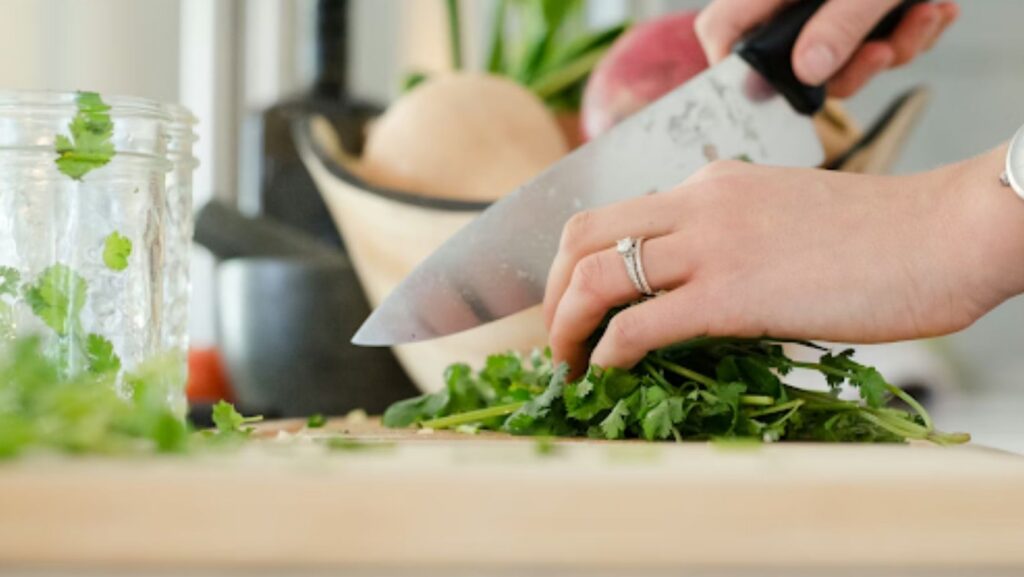
Once you begin, try to slow down your movements. Usually, we chop vegetables as fast as possible to save time. Instead, try intentional chopping. Notice the vibrant orange of a carrot, the crisp sound it makes when the blade hits it, and the earthy smell it releases. By focusing on these tiny details, you are practicing a form of meditation that doesn’t require sitting still on a floor mat.
Use the “waiting times” in cooking to your advantage. Instead of reaching for your phone while the water boils or the oven preheats, take three deep breaths. Feel the air fill your lungs and notice the warmth of the kitchen. This simple act of breathing prevents the “rush” from taking over.
You are also practicing gratitude. Acknowledge the effort it took for this food to get to your table—the farmers, the drivers, and the earth itself. This connects you to a larger world and moves you out of your own internal stress.

Tasting with Presence
As the meal nears completion, engage your palate. Tasting your food as you go isn’t just about checking for salt; it’s a grounding exercise. Focus on the four pillars of flavor: salt, acid, fat, and heat. Does the soup need a squeeze of lemon? A pinch of pepper?
By training your senses to notice these nuances, you are staying firmly in the present moment. This process also has a physical benefit: it prepares your digestive system. When you smell and taste your food mindfully, your body begins to produce the enzymes needed for digestion.
You aren’t just eating; you are preparing your whole self for a restful evening. You are signaling to your brain that the “hunting and gathering” (or working and stressing) part of the day is finished.
Final Thoughts
The final step is the most important: don’t rush the first bite. Even if you are eating alone, take a moment to look at what you have created. You have taken raw ingredients and turned them into something that will sustain you. That is a small, daily miracle.
You don’t need to be a gourmet chef to experience this. You can practice mindful cooking while making a simple piece of toast or a bowl of pasta. The “magic” isn’t in the ingredients; it’s in your attention. When you treat the kitchen as a place of self-discovery, dinner becomes more than just a meal. It becomes a daily ritual of coming home to yourself.