Western North Carolina rewards travellers who slow down. From the Blue Ridge Parkway to Asheville and Cherokee, the mountains shape a journey that lingers long after the road ends.
You do not really come to western North Carolina to tick things off.
You come because that stretch of the state has a way of getting into your head. The roads are slower than you thought they would be. The views keep delaying you. One stop turns into three. A quick coffee in Asheville becomes an afternoon. By the time you are dropping south toward Cherokee, the day has already slipped its schedule.
That is part of the appeal.
North Carolina’s official travel board splits the state into three broad regions, but the western one is the part that tends to linger, the Blue Ridge, the Smokies, the folds of mountain roads that make you feel as if the landscape is still in charge.
Where the road starts doing the talking
The obvious way in is the Blue Ridge Parkway.
Obvious is not the same thing as overrated. The road runs for 469 miles through Virginia and North Carolina, and the National Park Service still describes it as a slow-paced drive rather than a route for getting somewhere quickly. That turns out to be exactly right. You are not on it to make time. You are on it to lose track of it a little.
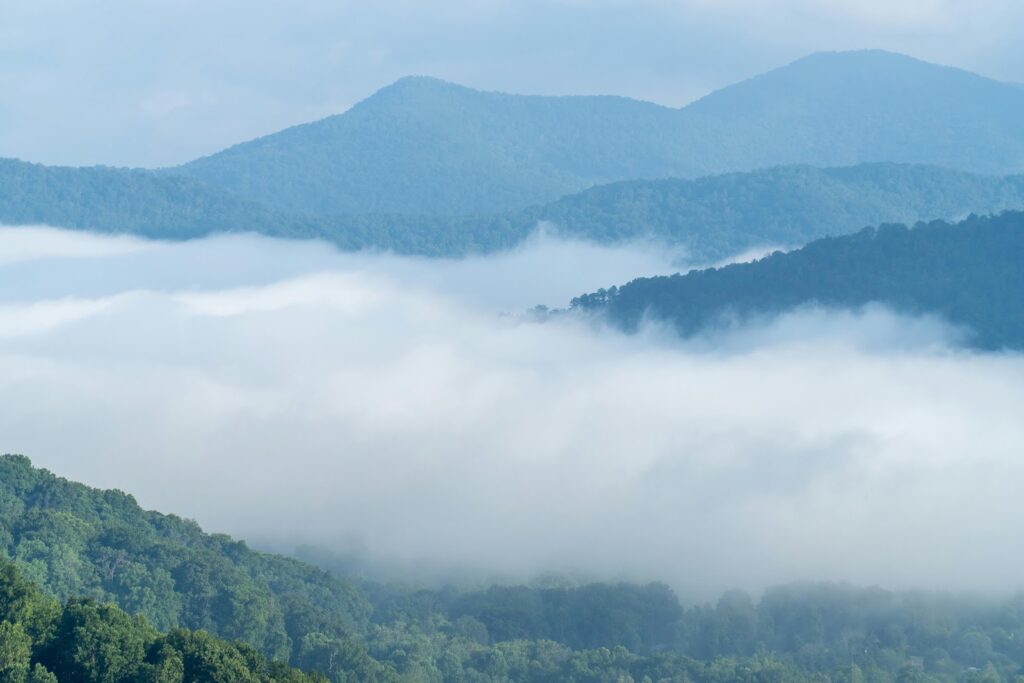
What stays with you is not one grand reveal; it is the repetition of smaller ones. A pull-off that looks unremarkable until you step out. A ridge line fading from green to blue to grey. The way the air changes when you get higher. You start understanding why people talk about the mountains here with a kind of local possessiveness. They are not just scenery. They shape the pace of the day.
Near Asheville, the parkway visitor center sits at milepost 384, which makes practical sense if you want to get your bearings, but the better approach is to leave room for the places that were not on your plan in the first place.
Asheville is better when you stop trying to “do” Asheville
Asheville has developed a reputation over the years, and parts of that reputation are deserved. The city sits comfortably within the Blue Ridge Mountains and has built a culture around craft beer, independent shops and live music that rarely feels forced.
Yes, the Biltmore is there, and yes, downtown is full of breweries, music and shops that know exactly who they are. But the city’s real charm is in the looseness of it. You get there thinking you will stay two hours. Then you are in a bookstore. Then you are standing on a sidewalk listening to someone play fiddle badly but enthusiastically. Then you are ordering another coffee because you are not ready to get back in the car yet.
The surrounding mountains add to that feeling. Trails, waterfalls and winding roads sit just outside town, and the combination of nature and small-city life gives Asheville its particular rhythm.
South of Asheville, the mood changes again
Keep driving and the road starts curving toward Cherokee.
The landscape grows quieter as the road dips deeper into the Smoky Mountains. Cherokee sits at the southern entrance to Great Smoky Mountains National Park, and the town carries a different energy from Asheville. Visitors come here for hiking, river walks and the sweeping views that stretch across the ridgelines.
That atmosphere changes slightly once evening arrives.
By then the hiking boots are back in the room, the daylight is thinning and the after-dark economy begins to surface. In this part of the state, Harrah’s Cherokee is not a random footnote. It has become part of the tourism picture, one of the places people mention once the talk shifts from overlooks and waterfalls to what there is to do once the mountains go dark.
Spend enough time around Cherokee and the focus often turns toward poker tables and the broader rules surrounding them. Visitors who grow curious about the legal landscape eventually come across guides explaining online poker North Carolina, outlining how the state currently approaches internet poker, why no locally licensed platforms exist yet and how players typically access games despite the lack of formal regulation.
Those explanations point back to the same reality: while online poker has not been formally regulated in North Carolina, live poker still has a visible home inside venues like Cherokee, where the game continues to draw players travelling from across the state and beyond.
Why the western stretch works so well as a trip
Part of it is scale.
You can have a mountain morning, a city lunch and a casino-floor evening without ever feeling as though you have left the same story. The landscape keeps changing, but not so violently that the trip loses its thread. It just deepens. The roads become part of the memory. So do the pauses, the diners, the overlooks, the moments when you realize you are an hour behind and do not care much.
That also means planning matters more than people think. The parkway can close in sections because of weather, road work or storm recovery, and western North Carolina is one of those places where a neat itinerary can come undone quickly if you are too rigid with it. That is why it makes sense to sort out the dull but useful details before you set off, your route, your overnight stops, your backup plan and something as basic as travel insurance if you are stitching together a longer mountain run.
What makes this part of North Carolina memorable, in the end, is that it does not perform for you. It is not trying to impress you every second. It just keeps offering one good thing after another, a curve in the road, a cold overlook, a city that lets you linger, a town that comes alive later than you expected. That is harder to fake than spectacle.
And it is why western North Carolina feels less like a checklist destination than a place you keep replaying afterwards, usually at the exact moment you thought you had moved on.