You have booked the flights, found somewhere to stay and started making a list of everything you want to see. Then, while checking the entry requirements, you notice that your passport needs renewing or that your visa application requires a new photograph.
It seems like the easiest part of the process. Take a picture, upload it and move on.
That is often where the trouble begins.
A passport photo can look perfectly good on a phone and still be unsuitable for an official application. The face may be slightly too high in the frame. A shadow may fall across the wall. The image may have been compressed after being sent through a messaging app. Even a subtle camera filter can create a problem.
None of these mistakes feels serious when you are taking the photograph. They become serious when an application is delayed and the departure date is getting closer.
“Passport Size” Does Not Mean One Size
One of the most common misunderstandings is that passport photos follow a single international format.
They do not.
The required dimensions can vary by country and document. A passport, visa, residence permit and driving licence may each use a different crop, background or file format. Printed photographs may also follow different rules from images uploaded online.
This is easy to overlook because the finished pictures often appear almost identical. The differences may amount to a few millimetres, a particular head position or a minimum digital resolution.
Those details matter.
Reusing a photograph from an earlier application may save time, but only when the new document follows the same rules and the image is still recent enough. Before taking or uploading anything, check the instructions for the exact application rather than searching for a general “passport photo size.”
A Phone Camera Is Usually Not the Problem
Most recent smartphones can produce an image with enough detail for an identity photograph. The bigger challenge is the way the picture is taken.
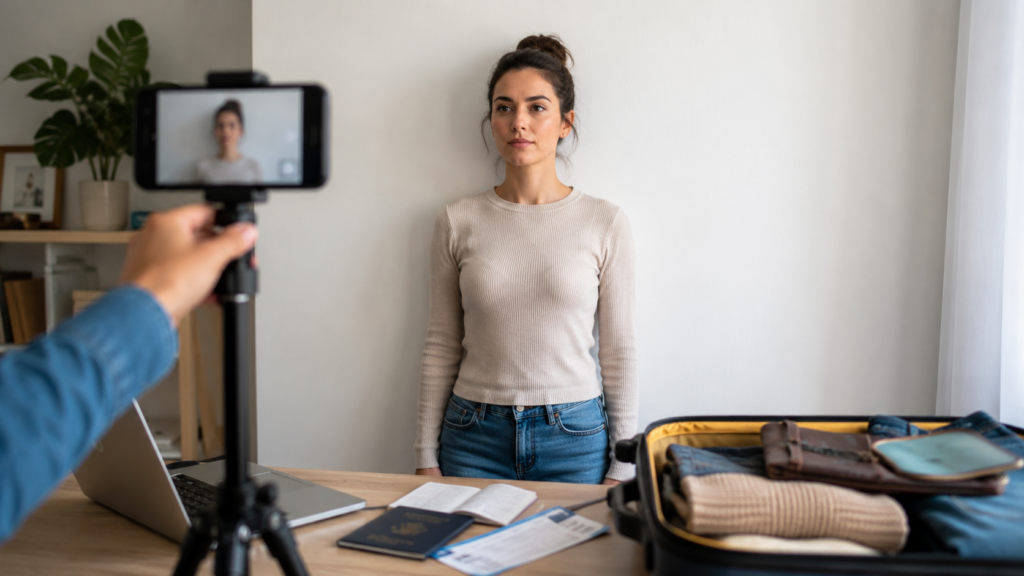
A close selfie is rarely the best option. Holding the phone at arm’s length can distort the face and makes it difficult to keep the camera straight. Asking someone else to take the picture usually gives a better result.
Lighting matters more than expensive equipment. Soft daylight from a window is often enough, provided the light falls evenly across the face. Direct flash can create glare, while a bright window behind the subject can leave the face too dark.
Take several pictures. It is much easier to choose the sharpest one afterward than to recreate the setup because the only photograph is blurred.
The Wall Behind You Can Ruin an Otherwise Good Photo
A plain wall rarely looks as plain in a photograph as it does in person.
Marks, texture and faint shadows become more visible once the image is enlarged. A picture frame may sit just outside your attention but remain inside the camera frame. Standing close to the wall can create a dark outline behind the head, while standing too far away may reveal furniture or a corner of the room.
A passport photograph does not need to resemble a studio portrait, but the background should not compete with the face.
Some online passport photo makers can separate the person from the original setting and prepare a plain background. That can be helpful.
Why Ordinary Cropping Tools Are Not Enough
Cropping a passport photo by eye sounds simple until you try to match a specific set of requirements.
How much space should appear above the head? Where should the eyes sit? How large should the face be in relation to the complete image? What pixel dimensions should the final file use?
A standard photo editor can resize an image, but it does not know which document you are applying for.
This is where specialist passport photo tools can be useful. A service such as PassportPhoto.online allows the user to choose the relevant country and document before preparing the image. The photograph can then be checked and formatted for that specific application rather than cropped according to a generic template.
The document selection is more important than the technology behind it. A perfectly centred photograph in the wrong format is still the wrong photograph.
No online tool can make the final acceptance decision, and applicants should always compare the result with the official instructions before submitting it. The benefit is that the measurements and initial checks no longer have to be guessed.
Small Mistakes That Are Easy to Miss
Some passport photo problems are obvious. Others appear only when the image is viewed at full size.
Glasses may reflect a nearby window. Hair may partly cover an eye or cast a shadow across the face. Portrait mode may blur the edge of the head because the phone has mistaken it for part of the background.
File handling can also reduce image quality. Screenshots and images saved from social media or messaging apps may be smaller and more compressed than the original camera file.
Use the original photograph whenever possible. Before uploading it, zoom in and check the eyes, edges of the hair and outline of the shoulders. Make sure the entire face is clear and that the lighting does not alter your natural appearance.
It is also worth checking the final file after it has been cropped. A strong original image can still become unsuitable if it is resized incorrectly.
Deal With the Photo Before the Trip Feels Urgent
Passport and visa paperwork is easiest when the departure date still feels comfortably far away.
Once flights have been booked, even a small delay becomes stressful. Processing times can change, an application may require additional information, or a photograph may need to be replaced.
Check the passport’s expiration date early in the planning process. Some destinations require it to remain valid for a particular period beyond the trip. Confirm whether you need a visa or travel authorisation, how long the application may take, and whether photographs must be uploaded, printed or both.
Then prepare the photo while there is still time to take another one if necessary.
It is not the most exciting part of travel planning, but it is one of the easiest problems to prevent.
The best passport photograph is not the most polished image or the one that took the most editing. It is the one that clearly shows the traveller, follows the correct requirements and passes through the application process without becoming part of the story.