
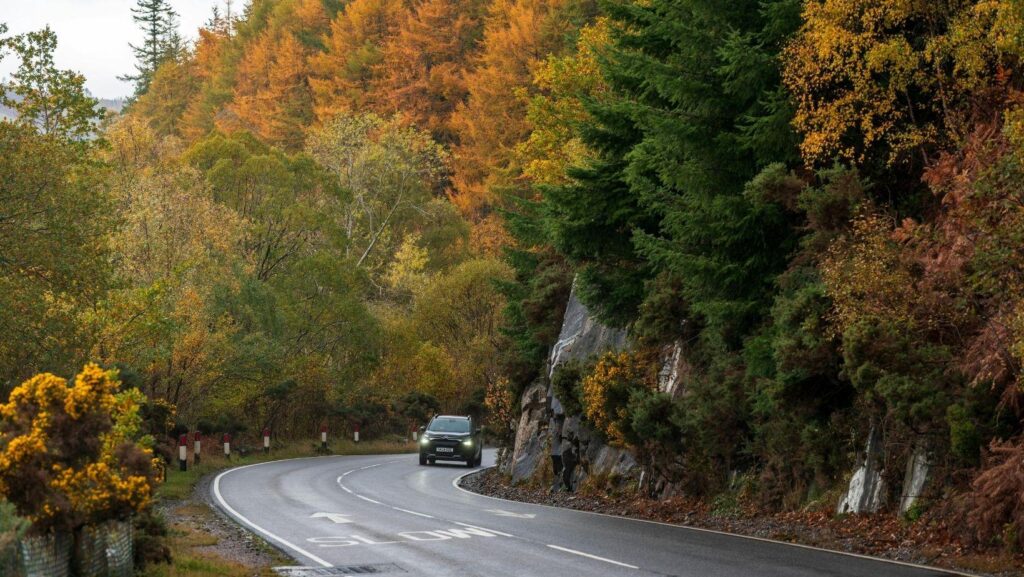
Rural roads can look simple compared with crowded city streets, yet their physical design can create different driving demands. The Federal Highway Administration (FHWA) identifies characteristics such as narrow lanes and shoulders, sharp curves, limited recovery areas, steep roadside slopes, and fixed objects close to the roadway as safety concerns on rural roads. Drivers may also encounter changing pavement conditions with little room to recover from a mistake.
Road geometry, visibility, pavement edges, drainage, and roadway maintenance can influence how much time and space a driver has to recognize a problem and respond. The following six conditions illustrate why a road that appears quiet may still demand careful speed selection, greater following distance, and sustained attention.
1. Narrow Lanes and Limited Shoulders Leave Less Recovery Space
Some rural roads have narrow travel lanes with little or no paved shoulder. FHWA’s guidance for local rural road safety identifies narrow lane widths and shoulders among roadway features that can increase safety risks. A shoulder gives a driver space outside the travel lane to recover control after drifting toward the edge and can also provide room for disabled or stopped vehicles.
When that recovery area is limited, leaving the lane can place a vehicle close to a ditch, embankment, vegetation, utility pole, or another roadside object. FHWA’s horizontal-curve guidance explains that shoulders can help drivers reclaim control during run-off-the-road incidents. Staying centered within the lane becomes especially relevant when approaching oncoming vehicles on narrow two-lane roads.
2. Sharp Curves Can Increase Vehicle-Control Demands
Horizontal curves change the direction of a roadway, and FHWA treats them as a significant roadway-departure safety concern. A vehicle traveling through a curve requires lateral tire-pavement friction to stay within its lane. The sharper the turn, the more carefully the driver has to match speed to the road’s geometry and available traction.
Curves can become more challenging when several factors appear together. Vegetation may reduce the driver’s view through the bend, the pavement may be wet, or the roadside may offer little recovery space. FHWA recommends treatments such as curve warning signs, chevrons, improved pavement markings, better roadside recovery areas, and high-friction surfaces at locations where additional protection is warranted.
3. Hills Can Restrict How Far Ahead Drivers Can See
Rural roads often follow the natural terrain rather than remaining level. A crest vertical curve—the shape created as a road rises over a hill—can restrict a driver’s line of sight to what lies beyond the crest. FHWA’s Speed Concepts: Informational Guide explains that vertical curvature affects available sight distance, including the distance a driver has to see an object and stop.
Restricted sight distance matters because a driver may encounter a stopped vehicle, intersection, animal, slow-moving equipment, or other obstruction only after reaching the top of the hill. Rural driveways can create another concern. FHWA notes that driveways obscured by steep hills, curves, trees, or buildings may limit visibility both for drivers entering the roadway and for motorists already traveling on it.
4. Pavement-Edge Drop-Offs Can Complicate Roadway Recovery
The transition between pavement and an unpaved shoulder is not always level. Erosion, traffic, resurfacing work, and shoulder deterioration can leave a vertical or near-vertical pavement edge. FHWA warns that these drop-offs can make it difficult for a driver who leaves the pavement to return smoothly to the travel lane.
This type of roadway feature helps illustrate why crash risks on rural roads cannot be evaluated by traffic levels alone. FHWA’s research on pavement-edge treatments explains that resistance from a pavement edge during reentry can contribute to overcorrection and loss of control. The agency promotes the SafetyEdge treatment, which creates a sloped pavement edge intended to make reentry more manageable if the adjacent shoulder drops below the pavement surface.
5. Water, Ice, and Poor Drainage Can Reduce Traction
Rain affects more than visibility. FHWA states that water on pavement reduces tire-pavement friction and can contribute to skidding or hydroplaning. Curves, steep grades, and approaches to intersections can be particularly demanding because vehicles need additional friction when turning, slowing, or stopping.
Drainage problems can make those conditions worse. FHWA’s rural-road drainage guidance explains that rutting, debris, vegetation, and pavement repairs can allow water to collect on or near the travel surface. Standing water may reduce available traction, contribute to hydroplaning, or freeze when temperatures fall. Reducing speed and increasing following distance gives drivers more room to respond when pavement conditions deteriorate.
6. Obscured Signs and Vegetation Can Reduce Advance Warning
Drivers depend on signs and roadway markings to recognize curves, intersections, speed changes, and other conditions before reaching them. Rural vegetation can interfere with those warnings. FHWA guidance on horizontal-curve safety specifically identifies grass, brush, weeds, and tree limbs as potential obstructions that can reduce sight distance and hide traffic-control devices.
Signs can also become less visible because of dirt, deterioration, poor positioning, or loss of retroreflectivity. The Manual on Uniform Traffic Control Devices establishes requirements for maintaining minimum sign retroreflectivity so traffic signs remain visible under nighttime conditions. On a rural road where a curve or intersection may not be obvious from a distance, delayed recognition can leave a driver with less time to adjust speed or position.
Rural Roads Require Attention to What Lies Ahead
Road conditions are often interconnected. A narrow road might also have a sharp curve, an unpaved shoulder, nearby vegetation, and wet pavement. When these factors combine, there is less room for error than a driver might expect on a quiet road. The Federal Highway Administration (FHWA) has rural road safety programs that aim to address these risks by improving road features such as markings, pavement edges, shoulders, friction, visibility, and recovery areas along the roadside.
Drivers cannot change how roads are designed or maintained, but they can adjust their driving in response to changing conditions. Looking further ahead, respecting warning signs, slowing down before curves and hills, giving extra space on wet pavement, and avoiding sudden steering if a tire leaves the road can help maintain control. Rural driving is safer when the open appearance of the road does not cause drivers to ignore its physical limits.