
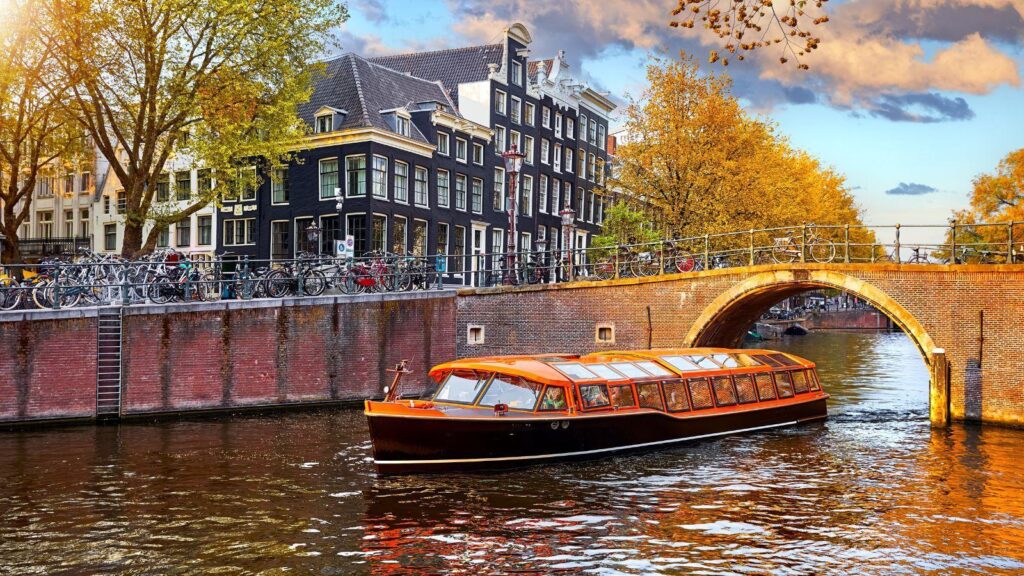
Every ranking of Amsterdam’s best canal cruises reads about the same. Nicest boat, friendliest guide, best cheese, book here. I read through a dozen of these before writing this piece, and not one mentioned that the city itself has spent the last several years actively trying to reduce how many tour boats operate on its canals. Digging into an Amsterdam canal cruise listing turned out to be a better way to actually compare which operators are keeping up with the newer rules. That’s not a small detail. It changes which operator is actually worth choosing, not just which one has the shiniest deck.
A Canal System That Wasn’t Built for This
Amsterdam’s canal network is old, dense, and small by modern standards. According to Wikipedia, the city has roughly 165 canals stretching close to 100 kilometers total, crossed by well over a thousand bridges, and the oldest of them, the Oudezijds Voorburgwal, dates back to 1385. None of it was built with modern tour boats in mind. By the 2010s, the sheer number of boats on the busiest stretches had become a real problem for the people who live along the water, not just an annoyance for tourists trying to get a clean photo. Noise complaints piled up. So did complaints about wake damage to old, unreinforced canal walls, some of which date back centuries.
Why the City Started Capping Licenses
The city’s response has been more concrete than most destinations manage. In 2020, Amsterdam redistributed its tour-boat licenses under a ruling from the EU Court of Justice, which found the city couldn’t keep issuing them indefinitely to the same operators. A third of the roughly 135 licenses went to new companies, and the city used the reshuffle to push newer, quieter boats onto the water instead of just renewing the old fleet automatically. On top of that, operators are being required to convert to fully electric boats, and a 2021 policy called Amsterdam Tourism in Balance sets a hard trigger: once overnight visitor numbers hit 18 million a year, the city council is obligated to step in with further restrictions.
What “Electric” Actually Changes on the Water
The electric-boat rule sounds like a small technical detail, but it changes the ride itself. I looked into what riders actually notice on the newer boats, and the list is longer than expected: no engine rumble, no exhaust smell drifting back over the deck, no need to raise your voice over the motor to hear the guide. Quieter boats also move differently through the narrow canals, since electric motors respond faster at low speed, which matters more than it sounds like in tight turns near old stone bridges. None of that shows up in a typical listing photo. It only shows up once you’re on board.
What That Means for Picking a Cruise Now
None of this makes booking a canal cruise a bad idea. It does mean the choice of operator matters more than it used to, since some companies are further along on the electric-boat requirement than others, and newer license holders tend to run smaller, quieter routes rather than the packed party-boat format the city has been trying to push out. Comparing options through a proper listing, rather than booking whatever boat is docked closest to the hotel, at least makes it possible to see which operators are running newer, smaller boats instead of the older diesel fleet still working through its phase-out.
The Limits of Picking a “Better” Operator
I want to be honest about how far this actually goes. Choosing a newer, electric, smaller-capacity boat over an old diesel one helps, but it doesn’t undo the deeper issue, which is simply how many boats the canals are asked to carry at all during peak season. One responsible booking choice by one visitor barely moves that number. The licensing reform is a structural fix working at a city level, and treating a single smart booking as a substitute for that would be giving myself too much credit.
Timing Still Does More Than Operator Choice
Even with a good operator, timing changes the experience more than almost anything else. Midday during the summer months is when the canals are at their most crowded, with boats often queuing to pass each other on the narrower stretches. An early morning or early evening departure avoids most of that congestion, and it also means fewer boats are burning fuel and idling in traffic at the same time, which is a small thing but not a nothing thing. Shoulder-season visits, spring and early autumn especially, spread the same demand over calmer water.
A Quick Way to Check Before You Book
None of this needs deep research before a trip. A quick look at how an operator describes its fleet is usually enough. Words like “electric” or “silent” in the listing are a good sign. Older listings that just say “classic boat” or don’t mention the engine at all are worth a second look, or a quick email asking directly. It takes two minutes and tells you more than any star rating will.
Doing It Without Adding to the Problem
None of this is a reason to skip a canal cruise on a trip to Amsterdam. It’s one of the more sensible ways to actually see a city built almost entirely around water, and skipping it doesn’t fix anything the licensing reform is already working on. What I keep coming back to is simpler than it sounds: the city itself has already decided the current volume of boat traffic is a problem, not a feature. Choosing an operator and a time slot that fits into that fix, rather than around it, costs nothing extra. It just takes noticing that the choice exists at all, which most of those glossy ranking lists never mention in the first place.