
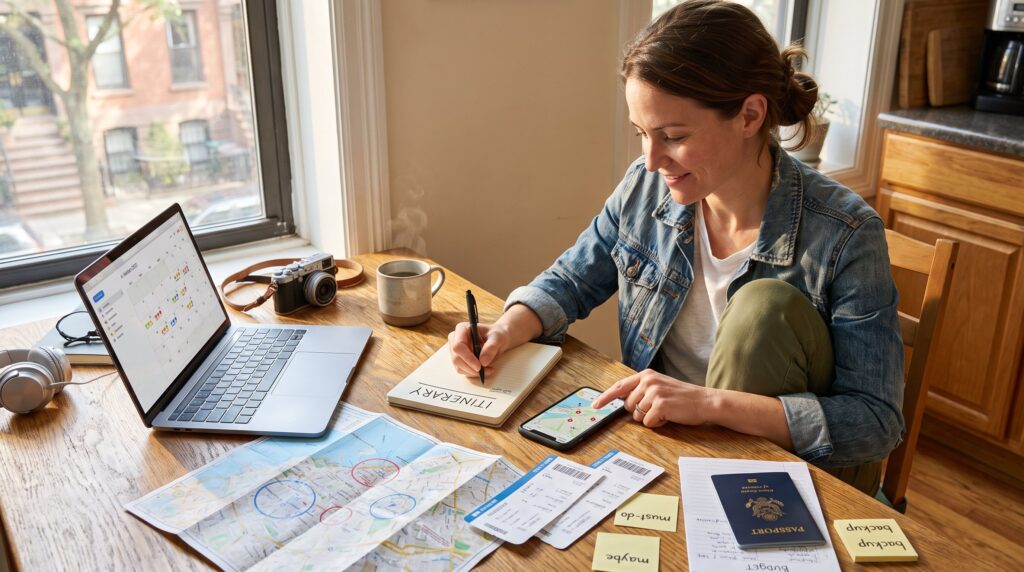
How to Build an Itinerary From Travel Inspiration starts with one clear decision: pick the travel idea worth turning into a plan. Inspiration, an image, a podcast episode, a friend’s story, becomes useful only when it matches a concrete goal, budget, and real-world constraints. This guide shows how they move from pinboard to day-by-day map, with practical checkpoints, booking priorities, and safety nets. It suits readers who want step-by-step structure without losing the serendipity that makes trips memorable.
Key Takeaways
- Building an itinerary starts by defining clear travel goals, budget split, and constraints to create a focused and feasible plan.
- Capture all travel inspiration in one place and prune it to a manageable shortlist with prioritized activities to avoid overwhelm.
- Group and map activities by geography and energy levels, scheduling high-priority items first for efficient daily flow.
- Tag each activity by type, duration, and cost to help balance the itinerary and identify booking priorities and dependencies.
- Allocate realistic time including transit and buffers, alternating active and low-key moments to maintain energy and enjoyment.
- Book flights and fixed-time activities earliest, keep flexibility with cancellation policies, and leave free time for spontaneous experiences.
Clarify Your Travel Goals, Budget, And Constraints
Answer first: what matters most on this trip. A clear top priority, culture, beaches, hiking, food, narrows choices and prevents overpacking activities. He or she should list one primary goal, one secondary goal, and three non-negotiables (dates, maximum budget, mobility limits). For example: “Primary: coastal surf days: Secondary: a cooking class: Non-negotiables: $2,000 total, travel dates fixed, no multi-hour hikes.”
Next, turn budget into actionable limits. Break the total into: flights (40%), accommodation (30%), local transport (10%), activities and food (20%). That split is adjustable but gives concrete caps. If a flight eats 60% of the budget, the itinerary must compress or shift to lower-cost accommodations.
Finally, log constraints that affect feasibility: passport validity, visa lead time, vaccine requirements, and travel windows tied to work or school. A simple constraint checklist prevents last-minute scrambles. When readers need packing or departure checklists, the site’s travel preparation guide provides step-by-step pre-trip tasks and timelines.
Capture And Curate Inspiration Into A Usable Shortlist
Key fact first: inspiration loses value if it’s not captured in a standard place. They must create a single shortlist and stick to it. Use one app or one document, notes fragment across apps and ideas die.
Start by collecting pins, screenshots, and bookmarks into a single folder labeled with the target destination and month. For each item add two short details: why it appeals and any immediate logistics (opening hours, rough cost, seasonality). This turns vague envy into evaluable items.
Then prune quickly. Keep five high-value activities per destination: three “must-do” items, one “maybe”, one “backup.” This trimmed list fits into a 7–10 day skeleton without overload. While curating, readers can reference comparative planning advice like the site’s planning practical advice to resolve common trade-offs between cost and experience.
Practical tip: use short anchor phrases inside the shortlist, “sunrise viewpoint (45‑min taxi),” “market cooking class (€60)”, so every selection already contains the next step of planning.
Prioritize, Map, And Build The Trip Skeleton
Immediate answer: group activities by geography and energy level, then place the high-priority items first. This avoids back-and-forth travel and fatigue.
Begin with a map view. Pin the shortlist on a map app and draw rough clusters, city center, coastline, mountain valley. Assign a priority score (1–5) to each pin based on desirability and feasibility. Next, slot high-priority items into the calendar on days when local conditions favor them (markets on market days, whale-watching in low seas).
A practical example: if a traveler has three coastal hikes clustered along the same road, place them on consecutive days and book the same base town. If a must-see museum is closed Mondays, place it earlier or swap with an open-day attraction.
While building this skeleton, consult comparative resources for accommodation and activity selection. The checklist in tips for comparing hotels before you book helps decide whether to base in one town or move nightly. Also consider responsible choices by reading the site’s piece on how to travel more responsibly when local ecology or culture could be affected.
Categorize Activities And Note Practical Details
Key instruction: label each activity with three tags, type, duration, and cost. That single line turns a wish into scheduling input.
Example line: “Snorkel trip, Activity: water, Duration: 4 hours, Cost: $85, Notes: includes gear, departs 8:00.” Another: “Old town walk, Activity: culture, Duration: 2 hours, Cost: free, Notes: closed Sundays.”
These tags feed the skeleton: morning active items + afternoon slow items: expensive activities sprinkled between low-cost days. The categorization also surfaces dependencies, tickets that must be booked early, seasonal closures, or age/mobility restrictions. When uncertainty remains, the site’s guide on how to find destination guides helps locate current local timetables and trusted local operators.
Vulnerable moment: many planners forget to tag transit time. Add realistic transfers (not Google’s optimistic times) and always add a 20% buffer for urban taxis and ferries.
Allocate Time, Distances, And Realistic Daily Flow
Short answer: treat time as the scarcest resource. They must schedule by moving minutes, not just activities.
Start each day by calculating door-to-door time: sleep to first activity, activity duration, travel between stops, meal breaks, and an evening buffer. A sample day: 8:00–9:00 breakfast + transit, 9:00–12:00 museum (3 hours), 12:00–13:30 lunch + stroll, 14:00–17:00 guided hike (3 hours), 17:00–19:00 rest and dinner. That layout reveals whether the day needs to be split into halves or compressed.
Distance realities matter. If two highlights are 90 minutes apart by local bus that runs twice daily, they belong on separate days. Use local timetables or regional ferry schedules when available. For help preparing travel logistics, consult the site’s travel agents AI discussion to see how professionals order multi-day routing and time buffers.
Practical warning: don’t stack three high-energy items in a row. Energy drains fast: alternate active and low-key slots to keep days enjoyable.
Booking Order, Flexibility, And Safety Nets
Direct answer: reserve the least available and most price-sensitive items first. Flights, long-distance trains, and special permits get top priority. Next book fixed-time activities (popular tours, concerts), then flexible items (museums with walk-in options).
Set explicit cancellation rules. Aim for options with free cancellation up to 7–14 days before travel when possible. For expensive, nonrefundable items, build a small contingency fund equal to 10% of the activity cost to cover last-minute changes.
Also prepare on-trip tweaks: keep one full afternoon free per week for spontaneous discoveries or for rescheduling due to weather. For digital assistance, travelers might use tools described in virtual assistants powering travel to manage confirmations and reminders.
Honest lesson: over-optimistic booking order is a common error, securing a nonrefundable tour before confirming arrival times forces forfeits. Book logically: lock travel, then lock time-bound activities.
Finalize Logistics, Bookings, Contingency, And On-Trip Tweaks
Final insight: an itinerary succeeds when it balances intention, realism, and slack. They should finalize bookings in the prioritized order, print or save a compact one-page plan, and carry copies of critical documents. Allow room for joy, reserve one unplanned morning to wander. With the right shortlist, map clusters, and booking order, inspiration becomes an achievable, memorable trip. For deeper destination ideas and structured planning support, see the site’s pillar on destination planning.