Walk into a really good Capri home and the first thing you notice is what isn’t there. No clutter, no gimmicky accent walls, no furniture straining to impress you. Just stone, wood, light and a lot of restraint. It’s a style that looks effortless from the outside and takes real discipline to pull off, and it has been quietly perfected on this island for close to a century.
What makes a Capri interior feel like Capri
The material palette barely changes from house to house: marble underfoot, rough local stone on the walls, fine wood for doors and beams, and white plaster everywhere else. The most famous example, Casa Malaparte, took that idea to an obsessive extreme. Its builders sourced Carrara marble, stone from Castellammare di Stabia, alabaster from Volterra and hand-carved woodwork from Rome, then had it all shipped to a cliff that could only be reached by boat or by mule. As ArchDaily’s design history of the house points out, every material choice was made to sit in dialogue with the cliffs and the sea rather than compete with them, which is really the whole philosophy of Capri interiors in one sentence.
That same discipline, real materials, few of them, chosen carefully, is what separates a good Capri house from a merely expensive one.
Villa Azzurra: where the materials do the talking
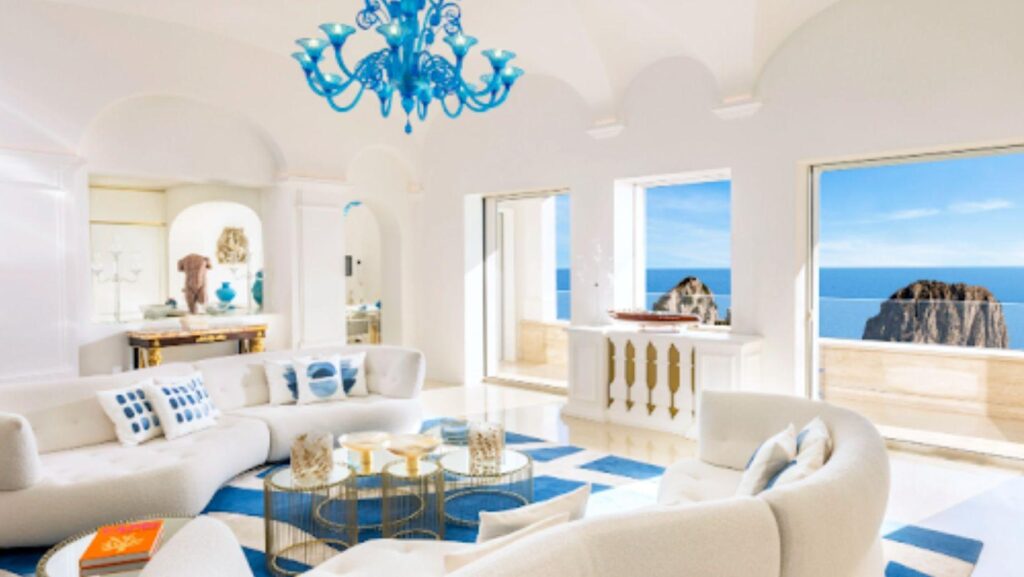
You can see the idea play out in full at Villa Azzurra, a luxury villa in Capri set above the Faraglioni and part of the Manfredi Fine Hotels Collection. Marble, natural stone and fine wood run through the whole house, and travertine floors paired with floor-to-ceiling glass mean the sea is visible from almost every room, not just the ones with a terrace attached.
The three suites each get their own bathroom, and the master suite is where the craftsmanship really shows: a double sink carved from one solid slab of marble, and a walk-in shower positioned so you’re looking straight out at the water while you use it. Every room is furnished with designer pieces rather than anything that reads as generic hotel furniture, which keeps the house feeling like somebody’s actual home rather than a rental. Even the kitchen, open to the main living space, is kept simple on purpose so it doesn’t pull attention away from the view or the materials around it.
Outside, the same logic continues onto the rooftop, where a pool, a bar and an open-air gym sit alongside a garden planted to soften the line between house and cliff. Nothing up there is trying to be a statement piece. The Faraglioni already are one.
A house that doesn’t try too hard
What strikes you most, once you’ve spent time in a few of these places, is how little they rely on decoration to feel luxurious. A Capri interior earns its warmth from the materials themselves: the coolness of marble underfoot, the grain in a wooden beam, the way afternoon light moves across a plastered wall. It’s a lesson that applies well beyond this one island. We’ve seen the same instinct at play on Sardinia’s coastline, where couples are increasingly drawn to properties that lean on stone and light instead of ornament.
Villa Azzurra fits squarely into that tradition. Strip away the address and the sea view, and what’s left is still a genuinely well-made house, built from materials that were chosen to last and furnished by people who clearly knew when to stop adding things.