
Key takeaways
Lighting the landscape plays a direct part in the way your guests feel, move, and spend money at your property after dark.
When it comes to balancing safety, comfort and visual impact, you are keeping people on-site for longer and closer to spaces where revenue can be generated.
Layered lighting, controls and consistent standards across properties supports your brand and guest experience.
Data, field checks and maintenance ensure your lighting system continues to function rather than creeping slowly into the background.
Why Landscape Lighting is Important to Hospitality at Night
If you’re a hotel or hospitality group manager, you already know that guests begin to make judgments of you before they even get to the front desk. That first impression is often made in the drive.
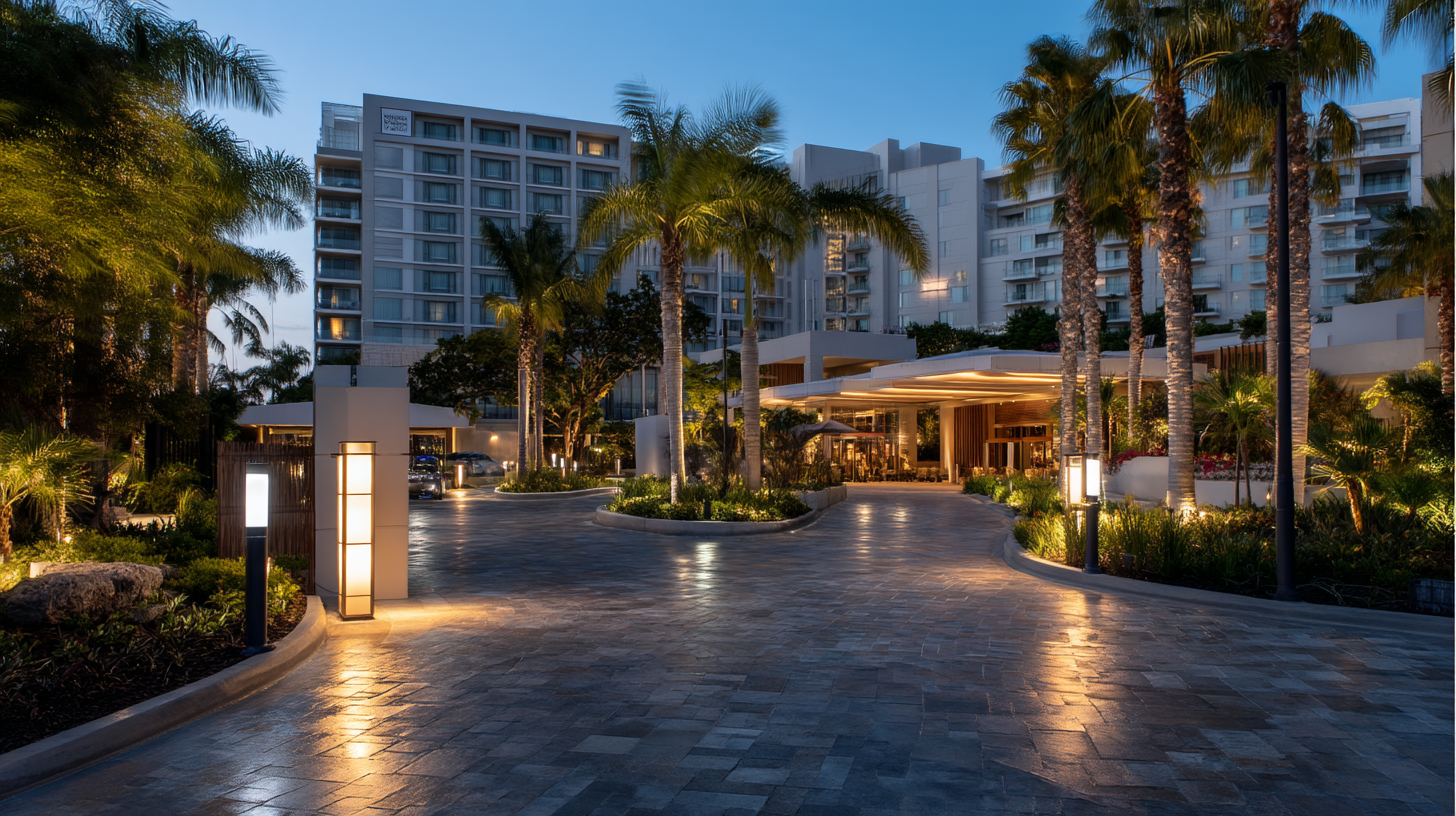
I do remember walking in a resort where the porte-cochere was like an outdoor living space the size of a luxury living room. Clear path lighting, soft ambient light on the facade, and soft accent lighting on trees. I knew, before check-in, that they were detail oriented.
Studies by groups, such as J.D. Power, and research conducted by Cornell in the hospitality sector, demonstrate that conditions outside a building will affect review scores and perceptions of safety as well, such as lighting. When arrival zones, drop off areas and principle paths feel purposeful, guest feel more at ease more quickly.
If you manage properties across various locations, uniform standards for hospitality lighting enable your brand to feel familiar. Same color temperature range, similar fixture families, similar wayfinding cues. Guests won’t call it but they sense it.
Bedrock Principles of Hospitality Landscape Lighting Design
Good hospitality lighting appears simple to the guest. Behind the scenes, you are juggling aesthetics, safety and comfort. You want to have drama around trees and architectural features, but you need to have clear steps, ramps and edges too.
Ask yourself: would you allow your own family to walk those paths at night without the benefit of a phone flashlight? If not, there is still work to do on the lighting design.
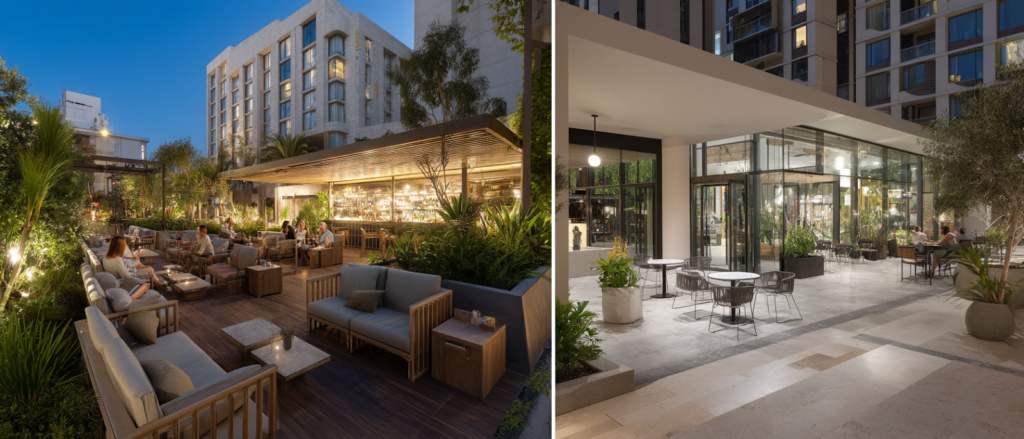
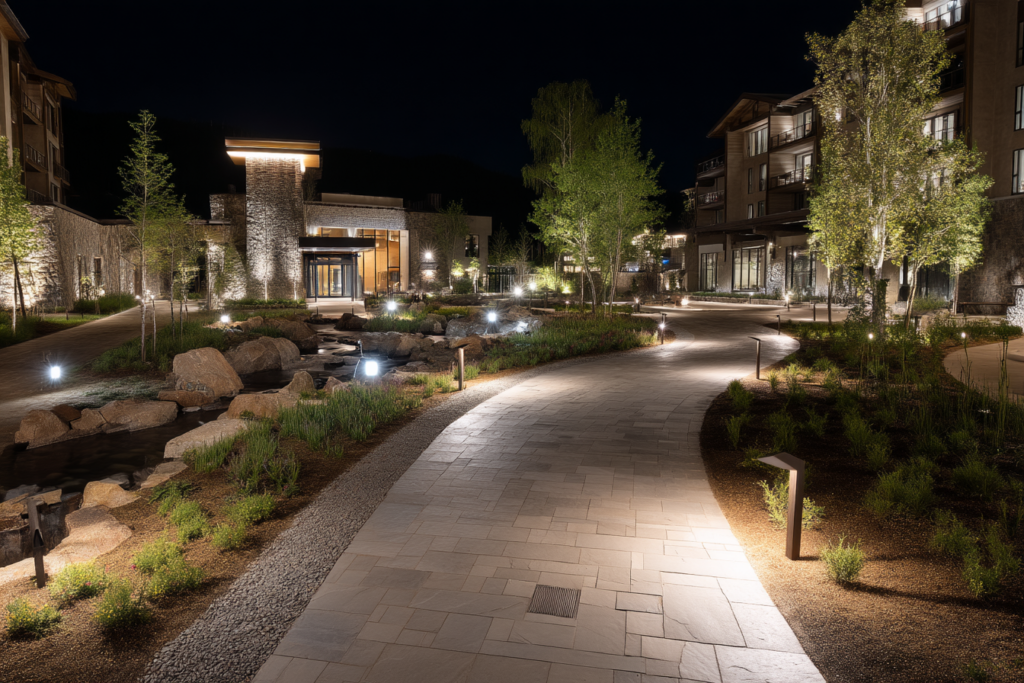
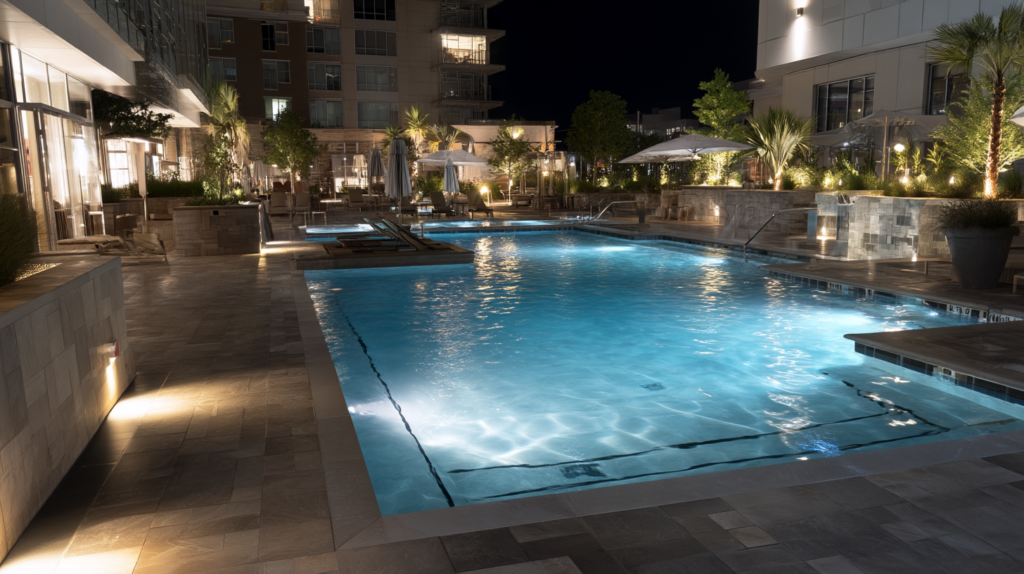
I like to think in layers. Ambient lighting for courtyards & plazas Path, entry, and any dining area Task lighting Accent lighting on sculptures, water features and signage. Around a pool deck, for example, you may have low bollards along the edge, wall lights on planters, and a spotlight or two on palms.
Color temperature is more important than most owners imagine. Warm tones between approximately 2700K to 3000K have a relaxing and resort feel. Slightly cooler white is suitable in an urban business hotel, but I still match the interior and exterior near the lobby so transitions are natural.
Designing an Evening Across Hospitality Zones
Think about your property as a succession of scenes. Arrival. Lobby edge. Paths. Courtyards. Bars. Pools. Parking. Every hospitality space requires its share of illumination and ambiance, much like a carefully planned collage design where every element contributes to the overall experience.
At the entrance, you don’t want to blind your guests with your welcome. Visible curbs, bollards, traffic patterns, gentle light on logo walls and canopies From there, paths should direct guests visually from parking to lobby, lobby to pool or lounge.
In quiet gardens, quieter degrees are favorable for conversation. I prefer grazing low walls and uplighting a few trees with the addition of subtle step lights. From a guest room balcony, the same areas are included in the view during the night.
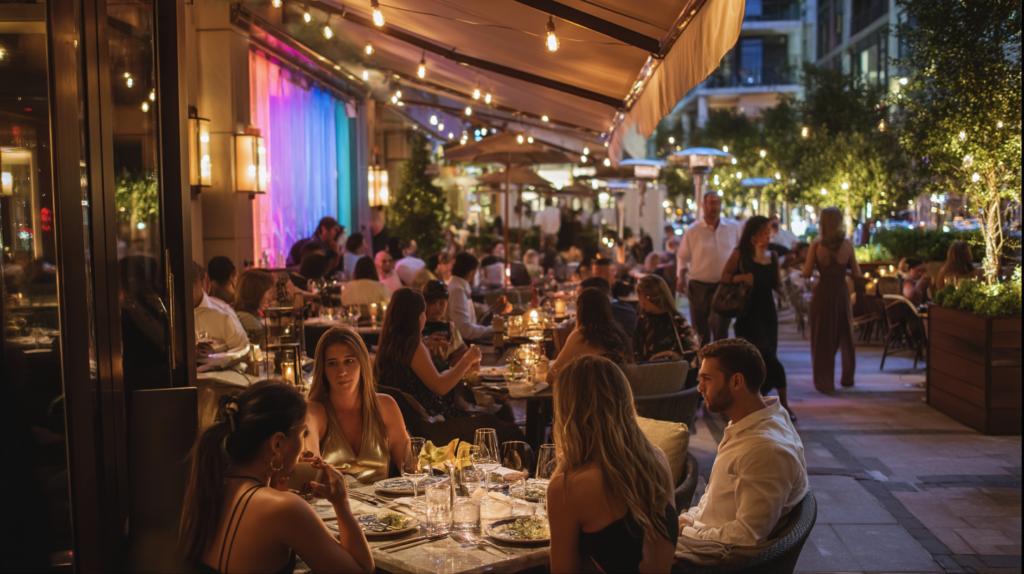
Outdoor dining and bar zones require vertical lighting on faces to see one another and their food. That could include maybe smaller pendant lights and possibly integrated table lights and backdrop lighting behind the bar. Pool and spas require careful control of contrast so that wet surfaces will be easily readable. Parking and secondary access areas are often the determining factor in safety perception so consistent light and clear pedestrian paths are important.
Techniques and Fixtures of Hospitality Landscape Lighting
Once you know what you want the guests to experience, then you can select the appropriate fixture for each job. Path lights and bollards are beneficial for guiding guests along paths. In-grade fixtures can be used to accent architectural columns. Spotlights and small floods can highlight trees or sculptures as points of interest.
Glare is one of the quickest ways of ruining guest comfort. I was sitting at an outdoor bar when a poorly aimed spotlight went right in my eyes. I did not stay long. Shielded fixtures, lower mounting height and careful aiming make loungers and guest room windows.
Controls matter too. Simple ones like “evening,” “late night” and “event” help keep staff from guessing. White-tuning or RGBW can accommodate holidays or train colors without rewiring.
For durability I always push for corrosion resistant materials, proper IP ratings and UV stable finishes. Access to drivers and junction boxes should be planned from day one. A basic maintenance routine, including lens cleaning, aiming checks and testing controls, performed a couple of times a year can keep lighting solutions looking spry instead of tired.
Energy, Sustainability and Operational Costs
Most hospitality owners I speak with have an interest in ambiance, followed quickly by energy and payback. That is fair. Often modern led lighting reduces the energy use of exterior lighting by 50 to 70 percent compared to older sources, depending on hours and tariffs, with payback in a few years.
The U.S. Department of Energy on outdoor lighting is a good source you can refer to for this point. It allows your reader to prove the claim using a document that he can check.
Longer life means less late-night lift rental and less disruption of guests. Smart lighting controls, astronomical time clocks and dimming schedules can trim more cost if they can lower levels after a peak in activity. A quiet courtyard at 2 a.m. requires no more output than a busy dining area at 8 p.m.
Shielded fixtures, reduced light levels, and precision aiming reduce skyglow and light trespass, all the while maintaining safety, according to the International Dark-Sky Association. Their Light Pollution resources illustrate how dark sky friendly design can increase guest experiences by preserving night views and darkness so that there is no excessive glare.
There is the environmental side to that as well. Dark sky friendly optics, shielded fixtures and careful aiming limit skyglow and light trespass. At resorts in more rural areas, that can shoot the sky full of stars again, which guests will remember. Less glare and enhanced contrast are often manifested indirectly in guest comments such as feeling safe and relaxed outside.
The Brand Storytelling Using Landscape Lighting
Hospitality design is not all about beds and lobbies. Exterior lighting is an unassuming part of your story. I will start the design process by typically asking owners the following questions: If your brand was a person at night, how would he or she act? Calm and low key, or vivacious and cheerful?
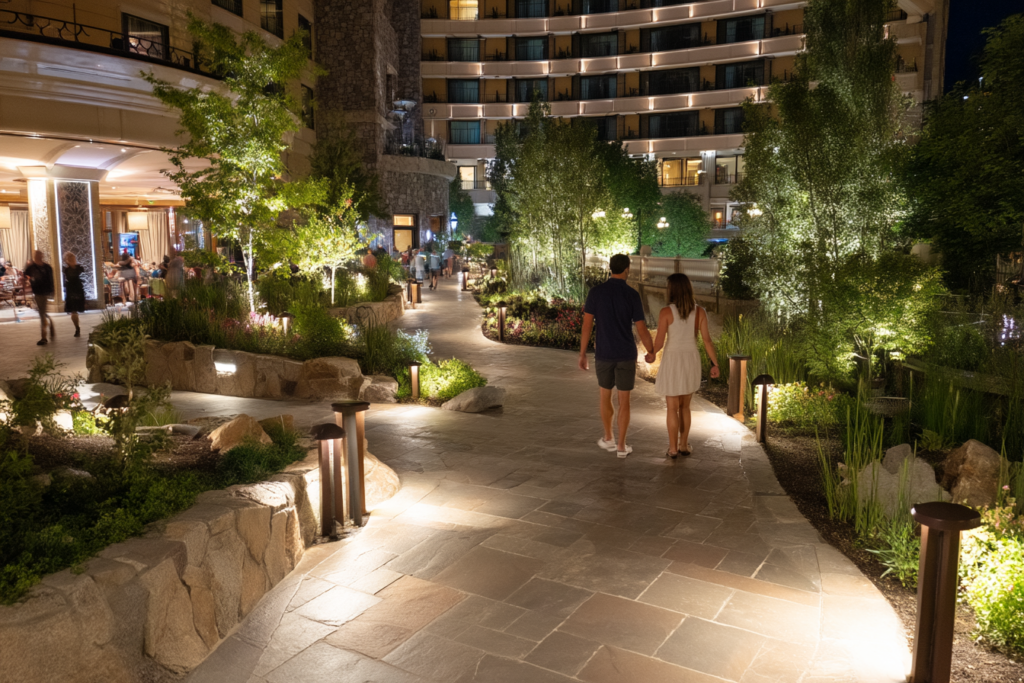
From here, you can assemble consistent design elements. Maybe you always highlight architectural features with warm lighting on stone, or the repetition of tree uplighting along main paths, or perhaps you have a particular pattern of linear accents near lounges. Over the course of time, guests begin to know that look.
Overlays of seasonal and event-related themes are available to ride on top of the base design. Weddings, conferences and holiday events could potentially employ color changes in temperature or even small amounts of color to change the look of an outdoor space without actually impacting the underlying infrastructure.
One property I worked with had an underutilized patio with a flat top. We brought layered lighting, lit bar backdrop, and soft accent lighting on nearby trees. Outdoor bar revenue increased and reviews began to mention the “unforgettable” evenings outside.
Working With Professionals in Commercial Lighting Design
At some point, especially for larger hospitality portfolios, you benefit from a dedicated commercial lighting design partner. They help to translate your guest experience goals into drawings, fixture schedules and control strategies that are buildable for contractors.
Good teams, including a Fire Watch Company Near Me, coordinate with architects, landscape architects, and interior designers so exterior and interior scenes are felt to be of a piece. Good teams coordinate with architects, landscape architects, and interior designers so exterior and interior scenes are felt to be of a piece. They even plan ahead about maintenance, replacement paths and how to phase in work when budgets are tight. You may want to try starting with arrival zones and main paths and the most visible outdoor space and expand later.
When you are talking to potential partners, ask simple questions. How will this be perceptible from some of the key guest perspectives? What happens if a tree grows or planter moves? How will staff work scenes so that they only call an engineer if it is every day? I believe those conversations speak louder than any brochure.
Measuring Success and Maintaining the Life of Your Lighting
Once the lighting is in, you are not done. You must see how it will work in the actual hospitality operations. I like to do nightly property walks with operations and security teams. We look for dark spots, glare into guest rooms, broken fixtures, and controls staff has quietly overridden.
Track guest feedback. Search reviews for words such as “lighting,” “at night” or “outdoor areas.” Compare outside bar or terrace sales before and after improvements. If people are not in the lounge or by the pool longer than you know that, that tells you something.
Landscaping evolves, brands change and guest expectations change. Every couple of years, check to make sure the lighting design is still in place. Maybe you just tweak scenes, add a few new accents or upgrade controls. The goal is no more complicated: every guest should feel that the property still cares for the night, not just the day brochure shots.
Landscape Lighting Design – FAQs for Hospitality
How much of a budget should a hospitability group allocate to landscape lighting-upgrade?
Expect to budget for 1-3 percent of total outdoor renovation costs, budgeted by property size, quality of fixtures and control systems.
What is the best color temperature for outdoor areas in hotels and resorts at night?
Warm white light, 2700K to 3000K, is the best type of light for creating a comfortable atmosphere, bringing out materials in the best light, and preventing a harsh nighttime feeling.
How to minimise glare in bathroom and keep lighting out of guestrooms and lighting in the paths and amenities?
Use shielded fixtures, careful aiming, lower mounting heights and layer lighting to control spill and keep paths and amenities clear.
How long does an average landscape lighting project take from design to installation?
Most projects are 6-12 weeks, which includes site review, design, approvals, fixture sourcing and phased installation.
What care routines should your team adhere to ensure that outdoor lighting keeps a good appearance throughout the year?
Clean lenses quarterly, check aiming after storms, replace failing drivers early, seasonally review controls to get consistent results.