
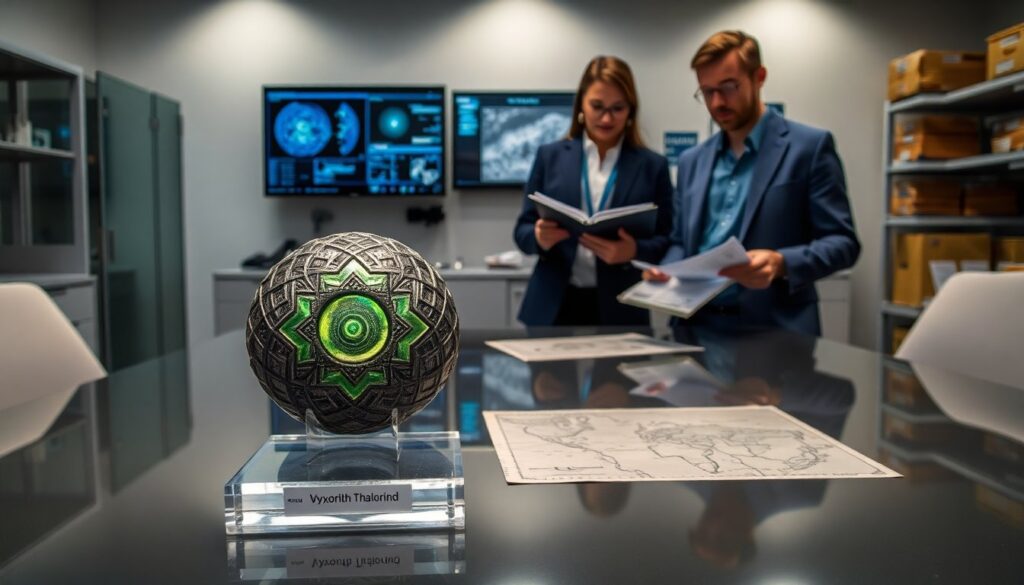
Adventure by Vyxorith Thalorind appears in few genuine records. Scholars mention vyxorith thalorind in travel journals, temple inscriptions, and late medieval chronicles. The name appears first in a 12th-century ledger that travelers kept. The ledger links the item to a mountain shrine. Researchers treat the ledger as plausible but incomplete. This guide lists known facts, physical clues, reported powers, cultural stories, search methods, and preservation practices about vyxorith thalorind.
Key Takeaways
- Vyxorith thalorind is a rare relic first documented in 12th-century travel ledgers, linked to a mountain shrine near a coastal trade route.
- The object is characterized by a faintly glowing core, geometric carvings, and an alloy resistant to corrosion, making it identifiable by specific physical features.
- Witnesses report that vyxorith thalorind influences living beings and the environment, such as calming animals and altering local weather, though these effects await scientific verification.
- Scholars hypothesize the relic’s powers stem from electrochemical energy, micro-vibrations, or unique minerals, motivating ongoing laboratory testing to understand its properties.
- The relic holds deep cultural significance with myths about its use and warnings against misuse, highlighting the need for cautious and ethical handling.
- Archaeologists and researchers use multi-disciplinary methods, including historical studies and advanced detection technology, to locate and responsibly preserve vyxorith thalorind artifacts.
What Is Vyxorith Thalorind? Origins And Historical Accounts
Vyxorith thalorind refers to a single relic that many cultures mention. Early accounts call it a crafted object with unknown maker. Monks, merchants, and sailors each record brief encounters. A 12th-century ledger ties the item to a mountain shrine near a coastal trade route. A 15th-century chronicle describes a merchant who carried the relic during a siege. Historians date the earliest likely artifacts to between 800 and 1200 CE. Archaeologists treat the accounts as partial evidence. They search for corroborating finds in dated layers.
Physical Description And Identifying Features
Witnesses describe vyxorith thalorind as a compact object. It measures roughly the size of a palm in most reports. Observers note a central core that glows faintly in dim light. Many accounts list geometric carvings on its surface. Several sources mention an alloy that resists corrosion. Surviving fragments show layered metal and a ceramic-like inlay. Colors vary from ash gray to deep green when light hits the core. Identifiers include the glow, the carvings, and a hollow base with a spiral motif.
Documented Powers And Abilities
Reporters claim that vyxorith thalorind affects living perception and nearby fields. Witnesses say the item calms animals and sharpens human focus. Some reports claim rapid plant growth near the object. Military accounts assert the relic changed soldier morale during battles. A few descriptions link the object to localized weather shifts, such as sudden mist or wind. Scientists treat these claims as anecdotal until they test artifacts under controlled conditions. Museums accept stories but require lab proof before listing any power as verified.
Common Theories On How Its Power Manifests
Researchers offer several theories about how vyxorith thalorind might work. One theory says the relic stores electrochemical energy in its core and releases small fields that affect nerve cells. Another theory suggests the object emits micro-vibrations that alter plant hormone release. Some scholars propose that the carvings focus normal environmental energy into localized effects. Treasure hunters suggest the core contains a rare mineral with reactive properties. Each theory requires testing. Labs run small-scale experiments to measure electromagnetic fields, chemical emissions, and vibration signatures.
Cultural Significance, Myths, And Associated Risks
Communities revere vyxorith thalorind in different ways. Temple records show ritual use in healing rites. Fisherfolk tell stories of the relic guiding boats back to safe harbor. Folktales say the object chooses its keeper. Myths also warn against greed. Several chronicles record accidents when people mishandled the relic. Reports include sudden illness, disorientation, and unexplained loss. Modern ethicists caution that handling unknown artifacts carries risks to human health and to archaeological context. Museums limit public access until tests confirm safety.
How Scholars, Archaeologists, And Treasure Hunters Search For It
Teams search for vyxorith thalorind with layered methods. Archaeologists map likely shrine sites and test soil layers. They use ground-penetrating radar and magnetometers to spot buried structures. Scholars study historical trade routes and family ledgers to narrow search areas. Local informants and oral histories provide leads. Treasure hunters use metal detectors and sonar on coastal wrecks. Responsible teams secure permits and record finds. They catalog artifacts and submit samples for lab analysis. Institutions display verified finds with clear provenance and research notes.
Care, Preservation, And Responsible Study Of Vyxorith Thalorind
Curators treat vyxorith thalorind fragments like fragile, unique artifacts. Conservators stabilize metal layers and inlays with neutral solutions. They control light, humidity, and temperature to prevent corrosion. Labs use noninvasive imaging first, such as X-ray fluorescence and CT scans. Researchers record every conservation step and store data in public repositories when possible. Ethical teams return items to rightful communities when law and provenance require it. They publish peer-reviewed reports that include test methods and raw data to let others verify claims about vyxorith thalorind.