
Want your hotel stay to feel like part of the journey—not just a place to sleep?
Travelers are increasingly choosing places that offer something beyond comfort: history, identity, and a sense of “this actually mattered before I arrived here.”
Because let’s be honest…
A perfectly modern hotel can be nice.
But sleeping in a building that once hosted bankers, royalty, railway passengers, or even entire economic systems? That hits differently.
And that’s exactly why heritage hotels are becoming one of the fastest-growing trends in luxury travel.
A hotel with a story can be:
- More memorable than standard 5★ chains
- Deeply connected to the city’s identity
- A built-in attraction, not just accommodation
Why Story-Driven Hotels Are Growing So Fast
This isn’t just a “vibe trend”—there’s real data behind it.
A few industry insights:
- Around 60–70% of luxury travelers say “unique experience” is more important than brand name
- Over 50% of millennials and Gen Z travelers prefer boutique or independent hotels over large chains
- Heritage hotel bookings in Europe have grown by 20–30% in the last few years, especially in cities with strong architectural history
Why?
Because travel is becoming less about “where you stay” and more about “what you feel while staying there.”
What Makes a Historic Hotel Actually Valuable?
Not every old building qualifies as a “story hotel.”
The best ones usually combine 4 key elements:
| Element | Why it matters | What guests notice |
| Authentic architecture | Creates visual impact | “You can feel the history” |
| Real historical function | Adds storytelling value | “This used to be a bank / station / exchange” |
| Central location | Connects to city identity | Walkable cultural experience |
| Luxury restoration | Keeps comfort modern | “Historic but still 5★” |
Why Travelers Remember These Hotels More
Psychology plays a big role here.
People remember:
- places with contrast (old + new)
- spaces with narrative
- environments that feel “irreplaceable”
A modern hotel room in Berlin vs. a hotel inside a 19th-century building in Berlin?
Only one becomes part of the story you tell later.
Example: From Stock Exchange to Luxury Hotel
One of the strongest examples of this trend is Manchester.
The city has a long financial and industrial history—once one of the most important economic centers in the UK outside London.
Right in its center sits a building that once symbolized that power: the former stock exchange.
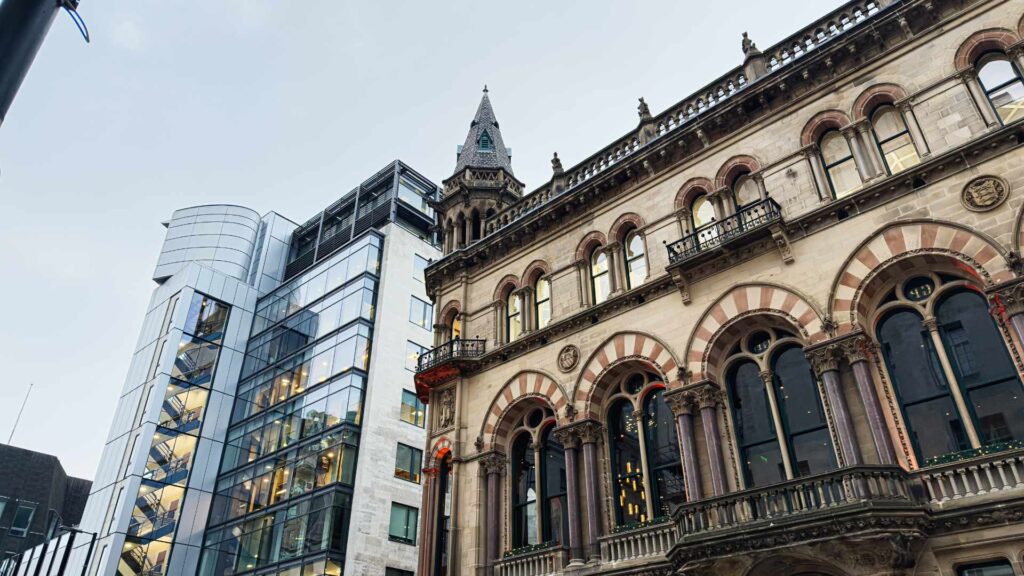
Today, it has been transformed into a luxury hotel: Stock Exchange Hotel.
Some quick facts that make it interesting:
- The building dates back to the early 20th century (Edwardian era)
- It originally served as a financial trading hub for Manchester’s economy
- The renovation preserved much of its original stonework and grand interior structure
- It sits in Manchester city centre, within walking distance of major cultural landmarks
What makes it stand out is not just luxury—but contrast: a place where money once moved markets… now hosts guests seeking experience.
That narrative alone is powerful.
Famous Types of “Story Hotels” Around the World
Here’s how different historic buildings are being reused in hospitality:
1. Former Banks & Financial Buildings
Old banks are naturally built to feel impressive. That’s why they translate so well into luxury hotels—thick stone walls, dramatic ceilings, and interiors designed to project trust and power.
- Vaults turned into wine cellars
- Trading floors converted into restaurants
- Strong architectural presence = instant luxury feel
Example: The Ned
This former banking hall in London has become one of the city’s most iconic luxury hotels.
Fun fact: The Ned has hosted a wide mix of high-profile guests, including celebrities during London Fashion Week and major film premieres, thanks to its central City location and exclusive members’ club atmosphere.
2. Railway Stations
Few buildings feel as cinematic as old train stations. Built during the height of the industrial revolution, many feature 10–20 meter ceilings and vast open halls designed for movement and crowds.
- High ceilings (often 10–20 meters)
- Huge open halls
- Built for movement → now built for stay
Example: St. Pancras Renaissance Hotel
A Gothic Revival masterpiece attached to one of London’s most famous stations.
Fun fact: The hotel famously appeared in several films and was once used by The Beatles for press photos when arriving in London via St. Pancras.
3. Palaces & Noble Residences
These are often the most visually dramatic hotels—centuries-old buildings once reserved for royalty or aristocracy, now open to guests.
- Often 200–500+ years old
- Some retain original frescoes, chandeliers, or royal furniture
- Rooms often unique in shape and layout (no standard design)
Example: The Ritz Paris
One of the most famous palace hotels in the world.
Fun fact: Coco Chanel lived at The Ritz Paris for over 30 years, and Ernest Hemingway reportedly “liberated” the bar after World War II.
4. Industrial Buildings
Factories, warehouses, and industrial sites are now some of the most popular conversions in modern hospitality. Their raw materials—brick, steel, concrete—create a naturally stylish aesthetic.
- Warehouses → loft-style hotels
- Factories → design hotels
- Raw materials = modern industrial luxury
Example: The Hoxton, Amsterdam
Built inside former canal houses and warehouse-style structures along Amsterdam’s canals.
Fun fact: The Hoxton concept has become especially popular among creatives and digital nomads, with many guests staying weeks rather than nights due to its “home-meets-hotel” atmosphere.
Why This Trend Works So Well in Cities Like Manchester
Manchester is a perfect example because:
- It was one of the world’s first industrial cities
- It became a major financial and trading hub in the 19th–20th century
- It has a dense concentration of historic architecture still standing today
So hotels like the Stock Exchange Hotel don’t feel artificial—they feel like a continuation of the city itself.
Why This Trend Will Keep Growing
A few reasons this isn’t going away:
- Cities are running out of space for new iconic buildings
- Adaptive reuse is more sustainable than demolition
- Travelers are prioritizing “meaningful experiences” over quantity
- Social media rewards visually unique stays
In short: A hotel with a story is more Instagrammable, more memorable, and more emotionally valuable.
When the past is still present
A bank becomes a restaurant.
A station becomes a lobby.
A palace becomes a suite.
A factory becomes a design hotel.
And in each case, the past doesn’t disappear—it becomes part of the guest experience.
That’s why travelers remember them long after checkout.
Because you’re not just staying in a hotel.
You’re staying inside a story that already existed long before you arrived.