
BOULDER CITY — Walk through Boulder City Municipal Airport (BLD) on any given morning, and the rhythm of operations tells a clear story. Helicopters lift off in steady rotation. Twin-engine Cessnas and Twin Otters taxi out for departures to the Grand Canyon. By midday, the apron is a working environment built almost entirely around tourism.
This is the financial backbone keeping dozens of secondary U.S. airports operational. While major commercial hubs dominate aviation headlines, regional fields like Boulder City, Sedona, and Kahului depend on scenic flight operators to sustain fuel sales, hangar leases, and landing fee revenue. Without them, the economics of running these airports would collapse.
The Scale of the Scenic Flight Market
The U.S. air tour industry is larger than most aviation observers recognize. The FAA estimates that more than 700,000 commercial air tour flights operate annually across the country, with the Grand Canyon corridor alone accounting for a significant portion of that activity.
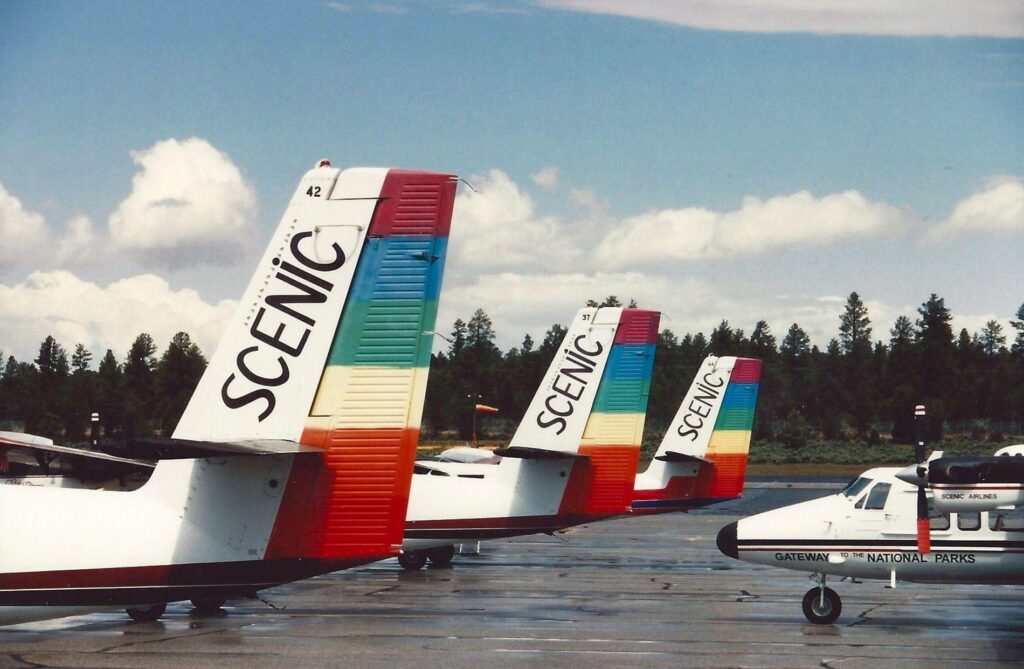
Operators in the Las Vegas–Boulder City basin run thousands of flights per month during peak season. Papillon Grand Canyon Helicopters, generally regarded as the largest scenic helicopter operator in the world, dispatches its fleet of EC130s and Bell 206s from facilities adjacent to Boulder City Municipal. Maverick Helicopters, Sundance Helicopters, and Grand Canyon Scenic Airlines maintain similar footprints, each contributing measurable economic activity to airports that would otherwise see fractional general aviation traffic.
The financial implications are substantial. Boulder City Municipal generated more than $2 million in operating revenue in recent fiscal years, the majority of which traces directly to tour operator activity. Similar dynamics play out at Page Municipal (PGA) in Arizona, Sedona Airport (SEZ), and several smaller fields throughout the Southwest.
How Tour Operators Underwrite Airport Economics
Fuel Sales as the Primary Revenue Driver
Jet-A and 100LL fuel sales remain the single largest income source for most general aviation airports. Scenic operators consume fuel at industrial volumes that recreational aviation cannot match.
A single EC130 T2 burns roughly 50 gallons per hour. An operator running ten airframes through a typical six-flight day generates fuel demand that exceeds entire weeks of activity at comparable airports without tour operations. This consistent, high-volume demand allows airport authorities to negotiate favorable fuel contracts and maintain on-field FBO services that would otherwise prove uneconomical.
Lease Revenue and Infrastructure Investment
Tour operators are long-term tenants. Papillon’s facilities at Boulder City include dedicated maintenance hangars, passenger terminals, and ramp space leased under multi-decade agreements. Maverick maintains similar arrangements at McCarran’s executive terminal and at its Boulder City facility.
These leases provide predictable revenue streams that municipal airport authorities can leverage for capital improvements. Runway extensions, taxiway upgrades, and lighting system modernizations across the Southwest have been financed in part through tour operator lease commitments. The relationship is symbiotic — operators need reliable infrastructure, and airports need anchor tenants.
The Las Vegas Corridor as a Case Study
No single market demonstrates this dynamic more clearly than the Las Vegas region. The metropolitan area supports scenic operations from Harry Reid International (LAS), the Grand Canyon West Airport (1G4), and Boulder City Municipal, with each field playing a distinct role.
Harry Reid handles a significant volume of strip-departure operations for travelers seeking Las Vegas helicopter tours and experiences over the city skyline before connecting to longer Grand Canyon excursions. Boulder City, with its closer proximity to the canyon and lower congestion, has become the operational center for fixed-wing scenic departures and the bulk of helicopter activity.
The geographic distribution allows operators to optimize aircraft utilization across different mission profiles. Short-duration strip tours, mid-range Hoover Dam circuits, and full Grand Canyon excursions can all be flown from appropriate facilities without competing for the same airspace or ground resources.
Operational Considerations Behind the Scenes
Fleet Composition and Maintenance Demands
The aircraft used in scenic operations are workhorses. Airbus H130s and AS350 B3s dominate the helicopter side, while Twin Otters and Cessna Caravans handle most fixed-wing scenic work in the corridor.
These airframes accumulate flight hours at rates that exceed most commercial operations. A scenic EC130 may log 1,200 to 1,500 hours per year — comparable to regional airline aircraft utilization. This intensity requires substantial on-field maintenance infrastructure, including the following operational elements:
● Engineering and inspection facilities certified for high-cycle rotorcraft operations
● Parts inventories sized for fleet rather than single-aircraft support
● Pilot training departments running continuous recurrent programs
The cumulative employment and capital footprint at airports hosting these operations far exceeds what general aviation alone would support.
Pilot Pipeline Implications
Scenic operators have become a meaningful entry point into commercial aviation careers. Pilots accumulating turbine helicopter hours at Papillon, Maverick, or Sundance frequently transition to offshore oil and gas operations, emergency medical services, or airline careers.
The same applies to fixed-wing operations. Pilots flying Twin Otters and Caravans for Grand Canyon Scenic Airlines build the multi-engine turbine time that regional carriers increasingly require. In this sense, scenic operators function as an informal training ground for the broader commercial aviation workforce.
Regulatory Pressures and Future Outlook
The scenic flight industry operates under unique regulatory constraints. The Grand Canyon corridor is governed by Special Federal Aviation Regulation 50-2, which dictates altitude floors, route structures, and aircraft volume limits. Hawaii operators face similar restrictions following several high-profile accidents that prompted FAA review.
These regulations create operational complexity but also serve as a competitive moat. New entrants face significant barriers to certification, which protects established operators and the airports that host them. The result is a relatively stable industry structure that allows for the long-term planning municipal airport authorities need.
Noise abatement remains the most persistent challenge. Communities adjacent to scenic flight corridors have pushed for stricter altitude minimums and operational curfews. Operators have responded with quieter aircraft — the H130 was specifically chosen by several Grand Canyon operators for its noise profile — but the pressure continues to shape route planning and fleet decisions.
The Broader Industry Picture
The scenic aviation segment is often dismissed as a tourism niche, but its role in sustaining regional aviation infrastructure deserves more analytical attention. Without these operators, dozens of secondary airports would face genuine questions about long-term viability.
The arrangement benefits both sides. Operators get reliable infrastructure, predictable airspace access, and proximity to their core customer markets. Airports get anchor tenants whose financial commitments underwrite capital improvements and operational sustainability.
As the industry watches the slow development of electric vertical takeoff aircraft and the potential restructuring of tourism aviation, the relationships between scenic operators and their host airports will likely remain a stabilizing force. Few segments of commercial aviation have proven as consistent in their economic contribution to the infrastructure that supports them.